Projects and News
Stay up to date on research and development projects and on the integration of drones in the airspace

skeyes, in its public service role, is keen to serve all airspace users, including future drone operators, in safety, operational and security domains. To achieve this objective, skeyes is involved in several projects and Research & Development activities in partnership with numerous actors (drone manufacturers, drone operators, remote pilots, IT developers, Airports, SESAR Joint Undertaking…). The goals are to prepare the implementation or development of new European regulations as well as to investigate new concepts of operations to be developed, paving the way for the harmonious integration of drones and manned aircraft activities.
Within SAFIR-Med, skeyes is involved in creating a concept of operations for the airspace management of urban environments (Urban Air Mobility). Additionally, skeyes is responsible for performing both the risk analyses and testing all the demonstration flights, as well as for organising the demonstration flights around the city of Antwerp. After the last demonstrations in the scope of the SAFIR project, skeyes uses a number of lessons learned to prepare the next set of demonstrations in this complex airspace.
Do you know how the integration of drones into air traffic is going? Our air traffic controller colleague Ive explains it all in this interview.
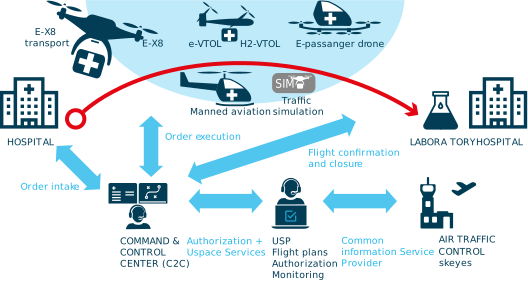
In the framework of SAFIR-Med, new actors will have to be involved to implement the support to medical operations as well as a communication chain.


This project is part of the SAFIR initiative to support medical operations (transporting medical equipment, urgent intervention…) with drones. The full name of this project is Helicus Aero Initiative – Scheduling Connectivity Security (HAI-SCS).
The aim of this project is to test and validate the capacity of the Helicus Command & Control Centre (C2C) to plan and to manage these flight paths in order to prepare future support for medical operations. To do so, Helicus intends to conduct a series of drone BVLOS (Beyond Visual Line Of Sight) flights in the EBAW CTR.
When performing BVLOS, where the drone pilot has no visual control, there is no technology available yet enabling them to comply with the EU regulation requirement to be in a position to avoid any risk of collision with other aircraft. Therefore, BVLOS flights are performed within TSAs specifically made for this purpose. Nevertheless, close coordination with the ATS units is established, preparing the future way of working between drones and ATS units.
In September 2021, during test days, a drone operated by Citymesh was used for bird control to detect, monitor and if necessary, direct birds away from the airport. Indeed, birds have to be kept away from the runways for aircraft safety. During these test days, the use of a drone as an additional tool to support the Brussels Airport’s Bird Control Unit was tested.
The drone was used for monitoring, inspection and mapping out locations of birds and other animals, especially in the most remote or hard-to-reach airfield areas. It was equipped with a speaker that replicated the sounds made by birds of prey to scare the birds and to keep them away from aircraft operations.
The goal of the test was to find out if the use of a drone for these tasks can increase the efficiency and to test and evaluate the possibilities of using a drone during normal airport operations.
The outcomes of these tests were very positive and will enable to go forward in efficient and reactive operational coordination procedures implementation between skeyes tower and the Airport operation center of Brussels Airport, which will be necessary for progressive integration of drones’ activities in airfield operations.


skeyes, in its public service role, is keen to serve all airspace users, including future drone operators, in safety, operational and security domains. To achieve this objective, skeyes is involved in several projects and Research & Development activities in partnership with numerous actors (drone manufacturers, drone operators, remote pilots, IT developers, Airports, SESAR Joint Undertaking…). The goals are to prepare the implementation or development of new European regulations as well as to investigate new concepts of operations to be developed, paving the way for the harmonious integration of drones and manned aircraft activities.
Within SAFIR-Med, skeyes is involved in creating a concept of operations for the airspace management of urban environments (Urban Air Mobility). Additionally, skeyes is responsible for performing both the risk analyses and testing all the demonstration flights, as well as for organising the demonstration flights around the city of Antwerp. After the last demonstrations in the scope of the SAFIR project, skeyes uses a number of lessons learned to prepare the next set of demonstrations in this complex airspace.
Do you know how the integration of drones into air traffic is going? Our air traffic controller colleague Ive explains it all in this interview.